Tag Archives: Balkan music

Sevdah: The perfect marriage of preservation and innovation

‘What connects me to traditional music is love…’

Dunja Bahtijareviฤ‡ is a poet, singer and translator. She performs traditional songs and explores musical contexts that breathe new life into them. Photo: Lav Turski via Balkan Diskurs, used with permission.

This article by Bojana Radiฤ‡ was originally published by the Post-Conflict Research Center on Balkan Diskurs and within the first edition of MIR Magazine. MIR, which means โ€˜peaceโ€™ in Bosnian is an annual publication and platform for young inventive people. An edited version has been republished by Global Voices under a content sharing agreement.

Sevdalinka (also known as sevdah) is the folk musical expression of Bosnia and Herzegovina. The word sevdalinka comes from the Arabic word sawda which means โ€˜black bileโ€™ โ€” one of the four bodily โ€˜humorsโ€™ โ€” that was believed to determine the melancholic state.

In Bosnian, sevdah took on the meaning of longing and of a zealous and sorrowful love. It is not possible to determine the exact period of the origin of sevdalinka, but it is assumed that it was created right after the Ottoman conquest of medieval Bosnia when the first urban settlements emerged. As they settled, the Ottomans brought with them certain musical traditions and melodies, which were representative particularly of the Asia Minor area. These melodies are part of a melodic system called makam and have their own characteristics, which the peoples of the Balkans adapted to their emotions with their singing. Sevdalinka is primarily an urban folk song of Bosniaks, but it is also popular throughout southeast Europe.

Musically, sevdalinka is characterized by a light, slow tempo and rich harmony, which leave a melancholy feeling with the listener. They are very structurally complex songs and imbued with emotions, and they are traditionally performed with a lot of passion and soul. Like any art form, the traditional music of this area has its laws, history and future, and many performers opt for more modern performances of older versions by adding their personal stamp.

โ€œThe sevdah I sing is a wonderful genre that combines poetry and music in a miraculous way. I see it as a field of new possibilities,โ€ reveals Damir Imamoviฤ‡, Bosnian musician, performer of traditional music, and singer-songwriter of sevdalinka.

He has performed in several bands and founded theย Damir Imamoviฤ‡ Sevdah Takht bandย in 2012. He also writes his own songs and says that nothing more than the inexplicable beauty of a text or melody will drive him to record a song. The song โ€œPjevat ฤ‡emo ลกta nam srce znaโ€ (Weโ€™ll Sing What Our Heart Knows) performed by Amira Medunjanin was written by Damir. Theย album โ€œSinger of Talesโ€œย received the Best of Europe award after being at the top of the Transglobal chart for months. Of the 100 best world music albums, he took sixth place and the album was also declared the best in the category of traditional music by the German Association of Music Critics.

Damir Imamoviฤ‡ stands as a luminary figure in the realm of Bosnian music, wielding expertise as a musician, singer, composer, and preeminent authority on the traditional melodies of Bosnia and Herzegovina, specifically the evocative โ€œsevdalinkaโ€ or โ€œsevdah.โ€ Photo: Almin Zrno via Balkan Diskurs, used with permission.

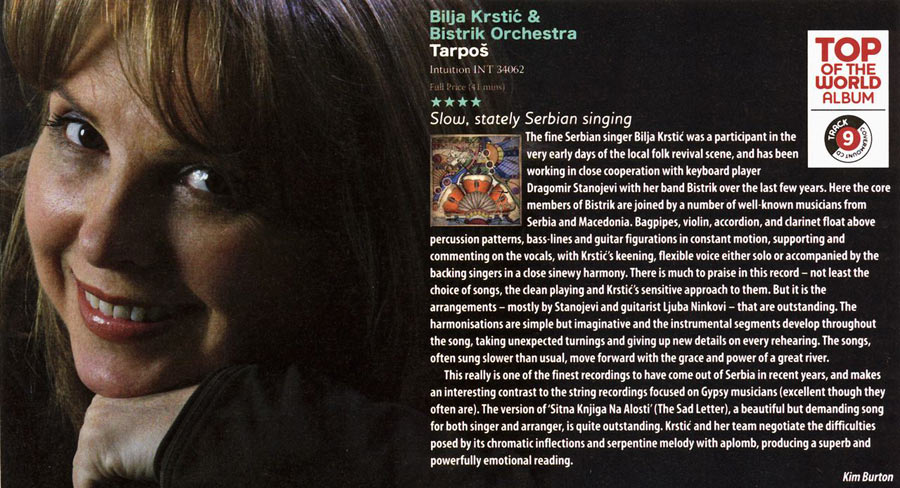
When talking about the best in the world of sevdalinka, it is impossible not to mention Biljana Krstiฤ‡ from Serbia. After a career in pop music, in 2001 she founded the Bistrik band through which she promotes ethno-musicological heritage. So far, they have released four albums: โ€œBistrik,โ€ โ€œZapisi,โ€ โ€œTarpoลก,โ€ and โ€œIzvoriลกte.โ€

โ€œTarpoลกโ€ featured in British world music magazine Songlinesโ€™ โ€˜Top of the worldโ€™ selection, as well as winning French magazine TRADโ€™Magโ€™s โ€˜Bravosโ€™ award for lyrics of the month.

In addition to many other numerous awards, Biljana Krstiฤ‡ and Bistrik received the โ€˜Vitez srpske muzikeโ€™ (Knight of Serbian Music) award in 2009, and in 2015 Krstiฤ‡ and Miki Stanojeviฤ‡ won the Grand Prix award for the music from the film โ€œBranio sam mladu Bosnuโ€ (lit. โ€œI Defended Young Bosnia,โ€ official translation โ€œThe Man Who Defended Gavrilo Principโ€).

Krstiฤ‡ says:

Those songs of distant ancestors both make me happy and heal me at the same time. When I just remember how much time I spent with old music and audio recordings, with archive and field recordingsโ€ฆ I listened to them God knows how many times, analyzed them, and learned to sing them. The source of traditional texts is always clear and strong. Those beautiful songs strike directly into the heart and flood the banks of all your senses. You feel as if time has been suspended, which is complemented by immense satisfaction and joy.

For Vera Josifovska-Miloลกevska from Macedonia, traditional music is also a living, breathing thing. She is the vocalist of Ljubojna, one of the most prominent and most representative bands of traditional music. The band was formed in 2001 and in 2005, they recorded their debut album โ€œParite se otepuvaฤkaโ€ (Money brings death โ€” a Macedonian proverb and theatre play).

In 2012, Vera Miloลกevska was chosen among the 12 best vocalists from the Balkans to participate in the Regional Cooperation Council project โ€˜Les femmes des Balkans.โ€™

โ€œWhat connects me to traditional music is love. These local melodies gain contemporary progression and expression through my singing,โ€ she says.

Vera Miloลกevska Josifovska is one of the most important contemporary performers of Macedonia. Photo: Vlatko Chachorovski via Balkan Diskurs, used with permission.

Among the newer performers of traditional music, it is worth singling out the Zagreb ethno-group Kazan. They were formed in 2012 and their debut album โ€œRuลพoโ€ was released in 2018. Singer Dunja Bahtijareviฤ‡ says that it is important for her that traditional music be reinterpreted within a contemporary framework.

Although there are different approaches, I think that traditional music is preserved by putting it in a contemporary context through adaptation and reinterpretation. At the beginning, I didnโ€™t even know where my desire for exploring traditional music came from. At first, the songs were just beautiful to me, and then I discovered the opportunity of marrying something very authentic in myself and something very universal, or even modern, in those songs. All the songs survived because people have found themselves in them.

For Bahtijareviฤ‡, as for the other artists, what is most inspiring is the dimension of time and the path that the songs have travelled from their inception to their current form.

For a playlist of sevdah music, see the link below and check out Global Voicesโ€™ Spotify account for more eclectic music from around the world.

This article is republished here under a media agreement by Shouts and Global Voices.

Roma Musicians Discuss Inclusion In Larger Czech Community

While festivals often feature live Romani music, mainstream media outlets largely ignore it.

Roma music band Bengas. Photo by Jiล™รญ Bernovskรฝ, used with permission granted by Migel Milan Horvรกt.

This article was written by Elmira Lyapina. It was originally published by Global Voices (GB) on July 1st 2021 and is republished here according to the media partnership between GB and Shouts.


While Roma people are the largest ethnic minority in Czechia, comprising about 2.2 percent of its population, they are considered one of the most stigmatized and discriminated minorities in the nation. But even with the discrimination and undue stereotypes, the Roma people continue to have a huge social impact and are extremely prominent in Czechia’s music scene.

This author conversed with representatives of Czechia’s Roma music community about the prejudge and discrimination they face, the latest news of Roma oppression, and the borderless nature of music.

Roma minority and their social exclusion

Anti-Roma discrimination was brought to the forefront last month after a Romany man was killed by the police on June 19. The death triggered a wave of turmoil and protests within the Roma community as some Roma media compared the conflict to the George Floyd murder in the United States. Although it was determined by forensic autopsy examination that the police were not responsible for the man’s death, the case drew attention to tensions between the Czech majority and Roma national and ethnic minority.

These tensions are nothing new, particularly when it comes to Czechia’s social and cultural dynamics. For instance, the Council of Europe (COE) recently noted, that many European school programs fail to acknowledge the Roma people in their curricula and many historical accounts related to the Roma are unobjective or incomplete and fall prey to stereotyping.

In its 2020 report, the COE recommended Czechia address the ongoing discrimination and prejudice against the Roma people by including their history in school textbooks and addressing the issue of propaganda and false information about Roma people on the internet and social media. They also warned Czechia regarding the lack of advancement on its Roma language programs, where elementary and high schools were supposed to offer Roma language classes. These initiatives are part of a 20-year plan to protect Roma people and Travellers and fight against racism, intolerance, and social exclusion.

Results of a June 2021 poll showed that 70 percent of respondents in Czechia expressed antipathy toward the Roma. 

Roma musicians and their social inclusion 

Roma music band Kale. Photo used with permission granted by Emil โ€œPupaโ€ Miko.

Despite the unpopularity and social exclusion of Roma as people, prevailing public opinion considers them a very musical nation.

Migel Milan Horvรกt from the band Bengas explains:

We are six musicians. We have no problem with fusion, the whole family plays some instrument. We play not only Romani-Gypsy folklore, but also a lot of Latin music, Balkan music (Kusturica or Bregoviฤ), Russian Gypsy music, Polish songs, funk, soul, and of course such evergreens as Bรฉsame Mucho.

Roma music is favorite among the general public, and world-famous Czech classical composers like Karel Bendl or Antonรญn Dvoล™รกk often included Roma melodies in their work. In recent years, Roma music can be found on almost every radio station, due to the popularity of the French Gypsy Kings or Czech-US band N.O.H.A., which are famous for their Roma-Latin style.

In the Czech pop music scene, there are a solid number of musicians of Roma origin, but they mostly sing mainstream melodies.

Horvรกt explains:

Czechs are a rock nation. Chinaski, Kabรกt โ€” these are the leading Czech musicians, which is listened to by almost every Czech. Jan Bendig, musician of Roma origin, is probably the only one who has established himself out of many Roma people.

Emil โ€œPupaโ€ Miko, a Roma musician and long-term member of the bands Vฤ›ra Bรญlรก and Kale disagrees:

โ€ฆon the Czech scene you can hear and see musicians of Roma origin, but they do not sing Roma music, but they rather are musically assimilated with Czech music or taste.

While live festivals throughout the country often feature Roma or Gypsy musicians, they are not included in many mainstream media channels.

Miko reflected on the issue:

We have been officially playing since 1996, when we released our first CD. Since then, we have played not only in the Czech Republic but also abroad, we have toured 36-37 countries. We play our universal music, it’s Roma music, positive, dance, that everyone likes.

Czechs perceive our songs positively, they even sing our songs along with us in our concertsโ€ฆ

However, when we tried to promote our music on radio, even through commercial channels, they refused to play โ€œblack musicโ€, due the fear of losing their listenersโ€ฆ In fact, since then did not changed much, they play old songs, for example of Antonin Gondola, or our old songs only if there is some โ€œgreatโ€ occasion.

Horvรกt expressed similar opinion:

The Roma are a musical nation, we have a musical tradition for centuriesโ€ฆ Our group is called Bengas, translated from Romani as โ€œdevilsโ€, since we play such energetic things and as fast as devilsโ€ฆ

Czech people invite us a lot, but privately, to their celebrations. We also play a lot at festivals. The Czechs like the way we play, it won’t take even 5 minutes before someone dances. Although, we are called as the โ€œband on which you danceโ€, however, on the Czech market, in larger scale it is hard to get, and I know it is on the basis of the nationality. Couple of times we were giving an interview to the Czech TV and radio, but none released our music, and they didn’t want to promote us in any wayโ€ฆ

Both address the issue of such phenomenon as Gypsy World Music, noting that the recent peak of acceptance and recognition of Roma music in Czechia was around 2004, which was connected with the world-famous band Gypsy Kings visit the country.

Horvรกt recalled that his band performed as the opening act on the Gypsy Kings concert in the T-Mobile arena in Prague:

We also travel a lot in Europe. There are only 4โ€“5 of us such Roma bands that travel around Europe. We lived in France for a while. Although, we try to avoid the negative thoughts, but when we compare the attitude, in Czechia, at the official level, there is a different relationship with the Roma than, for example, in France or even in neighboring Slovakia. Privately, Czechs, individuals, love us. But political discourse does not always benefit society.

While both musicians shared largely positive experiences of acceptance by the Czech people individually, they both agree that on a wider level discrimination exists, including media discrimination, prejudices, and difficulty finding housing for themselves or work for relatives.

When asked what Roma musicians need to gain to have equality in Czechia, Emil โ€œPupaโ€ Miko replied:

I think it would take time to change that mood, the mentality and the way people with different skin colors are perceived, as it is in the USA now.

Migel Milan Horvรกt concluded:

I believe, the future is in the hands of childrenโ€ฆ What I am most interested in, when we play, is the reactions of the children. If the child is interested in something, it is immediately recognizable. Adults can lie, but children will not. I know that. We played for over 10 years in orphanages. Plus, we’re all in the band around 50 years old now. It is important to stay positive, and Roma music is positive.