Category Archives: Interview

Pushing against hateful narrative with art: an interview with Bristol musician Krantz

Take discovering acid jazz at the age of 12, then studying classical music and throw some beatboxing into the mix, and you’ll have some of the pieces visible that make up Bristol musician and activist, Krantz.

After discovering his music on X (formerly known as Twitter) I contacted Krantz to learn more about his work. It was clear that the man uses all his talents very specifically, and directly, to tackle certain political issues that belong to his proximate surroundings as well as around the globe. One of his latest tracks is a piece of emotional, moving electronica, that is created around a speech from US Senator Nina Turner, which Krantz sampled and puzzled in with the music – as if the powerful words were performed to the music.

During recent Covid lockdowns, Krantz used all of his musical talents, every Sunday, to entertain his fellow neighbors by performing music from his garden patio. Later on, other neighbors and musicians started participating, sending tones across rooftops and lifting people’s spirits.

Krantz took a moment to answer a few questions to further explain his background, music, and future projects. Read his message to the world below and check out his webpage and socials to follow his music.

Halldór Kristínarson: Thank you for taking the time to answer a few questions! First of all, who is Krantz and how did you first get into making music?

Krantz: I’m a pianist, producer, composer, songwriter and beatboxer from Bristol who has a passion for politics and wants to help those speaking truth to power by sampling their spoken dialogue from Youtube videos to create impactful and memorable songs. I want to help them reach as far and wide as possible to show that people are leading the fight against those who continue to want to divide us.

I’m a classically trained pianist and after discovering Acid Jazz at the age of 12 and teaching myself to play Jazz and Funk, I also found a love for emotive classical music after hearing Samuel Barber’s ‘Adagio For Strings’. When I began composing on the piano I started beatboxing to give each piece it’s character/ genre and this ability to beatbox and play piano at the same time has led to me supporting the likes of the Dub Pistols, Kosheen and performing at the world-renowned Boom Town Festival on multiple occasions.

My passion for many musical genres is displayed in my huge catalogue of tracks which include Classical, Post Classical, Orchestral Dubstep, Electronica, Hip Hop, Jazz, Beatbox, Funk, DnB, House, Trip Hop and World Fusion and I look forward to continue sharing as much music of varying genres as possible in the future.

HK: Did you decide from the beginning of your career to use your music and your voice for good? Or did politics and protest come into your craft at a later stage?

K: Politics and protest definitely came the more I emotionally matured and realised the good fortune and privilege I’ve had by having opportunities and choices. Before deciding to use the dialogue of truth teller’s dialogue in my tracks, my own lyrics were always very zeitgeist and addressed social, political and environmental issues so it was a natural progression and perhaps was destined to happen.

HK: Why do you think music is such an effective vessel for protest and activism?

K: Most people won’t spend the time watching a debate, an interview or even reading full articles and mostly make decisions on very little information e.g. ‘get Brexit done’. To be able to deliver the truth and the words of truth-tellers to the general public we have to be creative and find vessels that push against the [mainstream media] narrative that are entertaining, memorable through repetition and help induce introspection- you can take a horse to water but can’t make it drink. People need to be in a neutral space away from bias or influence to truly reflect and this is where art and specifically music can be most powerful. I’m creating alternative versions and remixes of multiple dance genres for every song so that the dialogue has a chance to reach as far and wide as possible and for the tracks to be used in DJ mixes online, in bars, festivals, radio and in clubs. The hope is people really enjoy the music, find the dialogue intriguing, want to find out who’s delivering the lyrics and then hopefully start following that person.

HK: You mentioned via our chat, on the medium formerly known as Twitter, that Facebook and Instagram had suppressed your posts after sharing a certain song. Can you tell me more about that?

K: I produced a song and lyric video featuring the dialogue of Alexandria Ocasio-Cortez (AOC) called “The Insurrection” and when trying to boost a post containing the video, Facebook responded by saying it was inappropriate and was not following the rules and regulations. Ever since that point my exposure has been incredibly small and is proving to be a massive obstacle in sharing content with people even within my own social circles let alone the wider public. Twitter is the only platform that really offers me the opportunity to share content to a wide audience and therefore the potential for increased awareness and followers.

Krantz working on ‘We Must Stand Up and Speak the Truth ft. Nina Turner’. Photo retrieved from the official Krantz Facebook page.

HK: How is the scenery around you, music and activism-wise? Where you live and work, do you feel artists are using their voices to create change?

K: I very much keep myself to myself in regards to music creation however I don’t feel enough people are using their privilege and platform for positive means. I’m incredibly lucky to be in a position where I can make a difference in people’s lives and I feel it’s now my duty to make this happen. Fear and hate are constantly being fed to the public and we need to fight against this with an abundance of art filled with messages of optimism, truth and unity.

HK: Who are some of the artists or people that have inspired you?

K: Herbie Hancock, Samuel Barber, Hybrid, Outside, James Brown, Tower Of Power, Pink Floyd, Jazzanova

HK: What do you hope to achieve with your music?

K: I hope to help inspire other artists to produce their own political/protest art, for people to listen to the songs and be inclined to find out more about the featured speaker and to help sow some seeds that lead to introspection. Even if someone initially only engages with the composition hopefully through repetition, the lyrical content will start to penetrate their thoughts.

HK: What is on the horizon for you?

K: I’m continuing to produce a vast amount of songs with alternative versions and remixes which I’ll be releasing over the coming months. The next release is a track featuring James O’Brien (LBC) called “Twaddle Is Still The Order Of The Day” which is about the collusion between politicians and the right-wing newspapers. I’m looking to release it before the end of the year. I’ll then be releasing 3 different versions of a narrative I’ve created using Nina Turner- the song is called “Many Hands Make For Light Work”. The genres are classical, Jazz and Dub.

HK: Thank you again for participating. Anything else you‘d like to shout from the rooftops?

K: Want to say a massive thanks to yourself for putting the time and effort into trying to help make a difference. It’s not easy, you have to have self-belief, believe that hope can materialize and the aptitude to be able to keep on pushing. Keep up the good work as it will pay off and we will help to implement change.

When his body made other plans, he made music: Interview with Ban Summers.

The reasons for why someone starts making music are as many and varied as the stars at night. I reckon every human being can relate to having longings, wishes, plans and then having something in this existence, in some way, pull those plans apart and automatically create a new path.

For independent musician Ban Summers, from Portsmouth, UK, those forces were physical and inside of his body. But although being pulled in different directions Ban decided at one point to not let it control his final path. At a young age he picked up a guitar and he contributes his physical disability for that. Otherwise he’d likely be at the football field nowadays.

So in Ban’s case, music came out of that forceful pushing and pulling back and forth. Chill, lo-fi pop music which I recommend to everyone to check out. Ban has a new album coming out and an active radio show where he only plays music by disabled artists. You can follow his work via his Bandcamp page and other social networks.

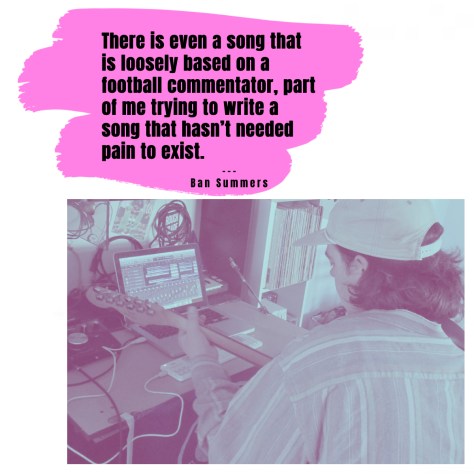
Ban Summers (photo courtesy of the artist)

Halldór Kristínarson: Thank you for taking the time to answer a few questions for the Shouts audience! For those who don’t know you, who is Ban Summers?

Ban Summers: Ban Summers is the helpful disguise of me, Edward Perry. I write, produce, mix, master and release all the music, so I’m a one man cottage industry. I live in Portsmouth and make all the songs at home.

HK: How did you get into making music? Have you always had creative tendencies?

BS: Before I was first ill, I played football all the time. With that all taken out of the equation as a young teenager, music became more and more important. I heard Lightspeed Champion’s (Dev Hynes/Blood Orange) Album In A Day and it blew me away. If he could make that in a day, I wondered what I could do in a year. Lidl had advertised a classical guitar, so I convinced mum to take me up there and I started to learn on it by myself. I then got an electric guitar for Christmas, I may have been 13/14 at this point. I didn’t really enjoy learning other people’s songs so I started to write a few songs and eventually uploading them to MySpace, which shows how long ago that was. I played my first gig at 15 on weekend leave from hospital, where I was for 8 months. I’m now 30 and released 2 albums and countless EPs and singles under several different projects.

I think I always did have creative tendencies but it was only because of my circumstances did I take the route into making music. It was one of those chance things in life and I’m grateful to have the outlet. I’m lucky I have a laptop, a microphone, a guitar, an amp and an audio interface and I can make music and release it on my terms.

HK: In your song, “Day In, Day Out” you sing the words “I made plans but my body made other plans”. I can imagine a lot of people can relate to those words, disabled or not. In the end, an “able” person is perhaps not able to make beautiful music although they are able to, say, jump. Lack of creativity, lack of empathy, lack of compassion – these things, to me, seem like a disablement. I for one salute you for the strength to put your creative voice out there, for the world to hear, and to be healed by. So, thank you for that.

BS: Thank you for saying so. I think for music to have become such an outlet, I needed to put some of myself into it. It’s daunting on the most part but when I wrote that line in Day In/Day Out, I was pleased to distill the chronically ill experience into it and the rest of the song. I don’t think I could ever get as close again to such a concise message that says so much.

I can’t really think of what happens after release and people hear it, it would make me too anxious. I want the music to connect of course but that isn’t the main reason for making it. I’m still making the music for myself and to give myself something to do.

HK: Has your music always had a conscious message?

BS: It’s often been personal or trying to say something. There are some songs that are maybe more subtle in their message but I’ve learned that there is power in being as direct as Day In/Day Out is. But I also want to learn to not have pain being a necessity to the music. Would I want to still make music if I was always happy, content and pain free? Of course, it would still be important to me. The world is still messed up, so there will always be something to say.

HK: What do you hope to achieve with your music?

BS: I want to create a catalogue of music that I’m proud of. I want to look back over albums and EPs of work and feel that I made something that was worthwhile. I don’t want to look back on numbers that can vanish if a platform closes down or become obsolete. Maybe recognition would be good for my ego, but that’s again not something I can control. My back catalogue and adding to it is something I can control.

HK: Why do you think music is an effective form of protest or activism?

BS: I think music, along with other forms of creative expression, has a way of getting into your head and soul. It doesn’t have to even be immediate or explicitly said, but once the music has pulled you in, then the message is given free reign on influencing you. Because of the melodies or the excitement, you start to remember what could be large pieces of text if it was written as say an article. You’re more likely to repeatedly listen to music than say an article or even a movie. So, music gets given a different space in our lives. And that bond between artist and fan/listener builds a trust that means you give more weight to what they are saying or the broader message. Of course, for some people they don’t care for politics or the message or they just want escapism, so maybe you wouldn’t be changing their minds anyway. But then if you speak or practice what you preach beyond your music, it can gradually change minds or attitudes. The artist and the listener both need to eventually put in that work for that to happen though.

HK: Can you tell me about your radio show Dis? What do you like about having that outlet?

BS: Dis is a four-weekly two-hour radio show on Portsmouth’s Unmade Radio, a community station that has so many amazing DJs covering so many different styles and you can listen live on their website, app or listen again on their Soundcloud. Dis features only disabled artists, with as wide range of disabilities or conditions as possible. Some artists may not identify as disabled, but they have experience of disabilities. Unmade Radio have been amazing in supporting the show and allowing me to record it remotely from home the whole time.

It’s great to have something that is bigger than myself. I think Dis has the possibility of having a greater impact than I do personally. One of the things that gives me joy is seeing artists played on Dis who then go and follow each other. A lot may well have been aware of each other but some won’t have been and it’s nice if I had some small part to play in that happening. I don’t think anyone has ever released music with the sole intention of it making it onto the show but I hope it gives a knowing nod saying “I see you”.

I love having the radio show, but it is exhausting for me to make and because of my energy or pain levels, the show can sometimes suffer. But that is real life as I’m chronically ill and disabled. I do what I can and Dis means a lot to me.

HK: What do you have on the horizon, music wise or in life in general? Rumor has it that there is an album on the way?

BS: There is indeed a new album. I only released Bean Summers last November but there was a lot of songs that flowed quickly afterwards and it was pretty much done 6 months after. But I wanted to allow people to get to know the songs a bit better, so I’m releasing it bit by bit at the moment before sharing the whole thing next year. I started with Drifting in May and now released Couldn’t Give A, which features shouting and sweary crowdsourced voice clips. The strange thing about waiting to release it is there’s even newer songs trying to fight their way onto it and maybe they will win out. The album could end up being quite a bit different to how it was intended a few months ago. There is even a song that is loosely based on a football commentator, part of me trying to write a song that hasn’t needed pain to exist.

In my wider life, we’ve just got Dottie, our 6-month-old rescue puppy and I have started writing about football finally, with an article on disabled football fans in When Saturday Comes magazine and helping out the England Amputee Football Association media team. It’s been great to find an outlet outside of music, which relieves some pressure on it, I think.

HK: Anything else you’d like to shout from the rooftops?

BS: I want to give a big shout to say thank you for taking the time to chat and shout like in Couldn’t Give A, with a big “f**k”.

Taking on the role of the animal: An interview with LoonRise (Arnaud Delannoy)

Searching the tags of the internet for new music can lead you into some exciting rabbit holes. This time I was in search of artists who use their talents to elevate the plight of those without a voice. Namely animals. I stumbled upon an album named “Eulogy for the Wordless Souls” by LoonRise. The name alone told me I was on the right path. From there though, it just became more and more interesting. Firstly, even if nowadays music is so incredibly mixed and inspired by the past, I have to say I was, pleasantly, surprised to hear the grunge coming at me through my very worn out headphones.

Personally, grunge played a major factor in my music listening early days, as for so many. But to hear it in 2023 and for it to sound fun and fresh, that just put a big smile on my face. The fact that the singer was then singing about animals, their liberation and humans’ connection to them, well, that just sealed the deal for me.

On the project’s Bandcamp page there is no social media links or nothing. Just a name for the artist responsible: Arnaud Delannoy. Turns out, he is a French multi-instrumentalist and composer who is, apparently, on a mission to learn how to play every instrument in the world. Or so it seems, judging by his moderately popular YouTube channel.

When I wrote to Arnaud inquiring about a possible interview, I told him I really enjoyed his album. He told me, humbly, that mine was the only feedback he’d gotten besides close friends. Which makes sense when you read the interview below – Arnaud has not rushed into telling the world about this particular part of his musical endeavours. Far from it, he is focused on his family and his goats and his countless other musical adventures as well. Good things happen slowly, someone said, and “Eulogy for the Wordless Souls” is a very good thing.

A kind and powerful thing.

Photo by Margaux Chalmel

Halldór Kristínarson: Thank you for taking the time to answer a few questions. I‘m very excited about sharing your album, Eulogy for the Wordless Souls, with the world. What can you tell me about your musical background and who Arnaud Delannoy is?

Arnaud Delannoy: I’m not going to tell my whole life here, I’ll try to make it short! I was taught classical music lessons as a child, first in piano, and much later in cello. Then, for the past 25 years, I taught myself around a hundred instruments, European classical, but also from all over the world. I have always focused my profession as a musician on instrumental diversity. I approached traditional musical styles from different parts of the world, composed and recorded symphonic pieces for classical orchestra, worked as a composer and performer for the theater… I have always done it all alone, writing, recording all the instruments, including mixing. It’s an advantage sometimes, but I’m starting to feel the frustration and the limits.

I’m like a newborn in the rock world! This idea popped into my head one year ago, but before that I hadn’t actually played an electric guitar in over 20 years, when I was in high school.

HK: When I first reached out to you about your grunge-rock, animal rights project LoonRise, you told me that besides a few close friends mine was the first feedback you were getting. And the project is not up on your other social media like YouTube. Why have you not wanted to share this awesome project with the world until now?

AD: I actually do have a YouTube channel which is quite well followed, thanks in particular to videos of exotic instruments. But this LoonRise project is so different that I didn’t want to mix everything up. My fear is giving listeners the impression of having engaged in yet another stylistic exercise by trying out rock music… However playing rock is an old, deep and above all sincere desire. So I chose to start from scratch and I created a new channel just for LoonRise. It’s not that I didn’t want to share this project with the world!

I’m at the very beginning of the process, my priority so far was to complete my album, I haven’t thought strategy yet. Should I find a music label ? Should I use promotion on social media ? Should I seek a financial support to start a group? These questions are not the most exciting for me, but I’ll have to seriously look into this.

HK: Since when have you had interested in the rights of animals? What motivated you to make a whole album about the subject?

AD: This position on animals comes from a long reflection, over several years. A decade ago, I was like everyone else, eating meat without even thinking about what was behind it. I began a relationship with a young vegetarian woman, who has since become my wife. Very slowly, and very gradually, her point of view began to open my eyes. The second trigger was when we took in goat kids rescued from slaughter. I quickly realized that what is usually referred to as «farm animals» are life companions as intelligent, endearing and sensitive as cats and dogs. From there, in my perspective, eating pork, beef, was no more justifiable than eating the neighbor’s dog. The line that we draw between the «friendly» and «edible» species no longer made sense – and going further, the line that we draw between human and non-human animals. So I started to learn more about the breeding and slaughter conditions of these farm animals, as well as the ecological impact of their consumption. And the more I learned, the more difficult it was for me to accept what is happening daily around the life industry.

When I decided to embark on this rock project, it was obvious to me that this was the subject I wanted to talk about. I had no desire to write about myself. Animals will never have the opportunity to express themselves in words, so I have, for most songs, taken on the role of an animal, imagined how by his eyes he could describe the tortures that humans inflicted on him – whether by his consumption, exploitation, hunting or destruction of his habitat…

But the album is not only about that, I also mention my concerns about the climate and ecological disaster towards which the human rushes blindly… but after all, animal cause and ecology are two sides of the same struggle.

This is what the name LoonRise says. I have long been moved by the call of the loons (which I unfortunately do not find in my country). These birds have a call full of mystery, one that best evokes the depths and secrets of nature. It is not without reason that it is so used, often wrongly and through, in the cinema, to create any wild nature atmosphere!

LoonRise means the uprising, the revolt of nature.

HK: When it comes to music who are some of your inspirations? What about in regards to your activism, what inspires you to use your voice and your talent in this way?

AD: Studies show that the music we listen to as teenagers will continue to affect us throughout our adult lives…  I started my adolescence in ’96, just after the grunge wave, but it still resonated in the middle school yard. Even if I listened to a lot of older rock, especially the period late 60’s – early 70’s, I remained more deeply marked by the music of the 90’s. My inspirations for this album are therefore obvious: Soundgarden, Pearl Jam, even Silverchair… and of course Nirvana.

This genre of rock also seems to me to be the most effective to carry the message I want to convey. It can be both heavy and gentle, it allows to sing, scream with rage but also whisper. It is not a necessarily dark and violent genre, there can be light, it can express hope. It suits me precisely because I do not define myself as a dark and desperate person.

Unlike metal, the melody is omnipresent, preponderant. I’m a big fan of melody, and that’s where I focus the most. It’s the key to getting into the mind of listeners. It is what we remember, that we listen above all. And in my opinion, it is what makes it possible to transmit a message…

Photo by Margaux Chalmel

HK: Why do you think music is a effective form of protest?

AD: As for the animal and ecological cause, is there really an effective way to protest? I have a lot of admiration for these young people who shout their despair at climate inaction by blocking roads, even sticking themselves to the asphalt, those who break the law by spraying red paint on butcher shops…  But they also attract exasperation and even violence. Openly protesting on these issues creates a fierce counter-reaction, and many reinforce their anti-environmentalist positions.

What seemed obvious to me is that it is very difficult to convince through dialogue regarding the animal cause. People are so much set in their ways, caring about their piece of daily flesh on the plate, that they turn away as soon as we try to question the human right to dispose of the life of animals. Many stubbornly refuse to know what is happening before the steak or milk bottle arrives in the supermarket aisle. Conversations often become aggressive, and never lead to anything. With meat, cognitive dissonance is very strong. I know, I was a willing victim of it for a good part of my life!

We need to find ways to get that message through the back door.

I don’t know yet if I will have a different impact with music. I would like to imagine that some listeners who will appreciate my music will be touched by certain sentences, certain ideas, that would emerge… But I don’t expect miracles. I won’t convert entire halls to veganism after a concert! This is a long path.

Anyway, for me, I couldn’t image expressing myself otherwise.

That said, it already worked a bit, a musician friend who helped me a few days to finish the mix decided, after leaving the studio, to stop eating meat. He was already on his way to thinking, but listening to my songs over and over prompted him to take another step. Who knows, maybe I’ve even spared the life of a chicken!

HK: What do you hope to achieve with Loonrise and the rest of your musical projects?

AD: As I said, in the LoonRise project, for the moment I am both well advanced, since the album is finished, but also at the beginning, since I have neither band nor public.

My priority is to find musicians to play the songs on stage, it’s essential if I want to expand my audience a little and make my lyrics heard by more! I’m not looking for fame or money with this project. I lead the life I want to have, and my priorities will always be to have time for myself, at home, with my wife… and goats. But I admit that I have been a solitary musician locked in his studio for too long, I would like to find again the thrill of being on the rock stage one day. Bringing these song to life together with other musicians would be a great achievement for me!

HK: What do you have coming up, project wise, musical or not?

AD: For now my life has gotten very busy, my biggest project right now is to finish renovating my house with my wife! Nothing to do with music, unfortunately, and it takes me a lot longer than making an album. Regarding the music, I should soon finish a project of Celtic « stock music » that I launched with a friend a few months ago. So it really has nothing to do with rock, since I play bagpipes, violin and harp!

In my personal projects, there is no shortage of desires, I still have many foreign instruments for which I would like to write compositions, full of symphonic themes that I would like to explore. And also, of course, I already have in mind the idea of writing new rock songs… But I think the first thing I’ll do when I get some time is make one or more video clips for the LoonRise project.

HK: Anything else you‘d like to shout from the rooftops?

AD: There are so many things I could shout from rooftops! I only mentioned the violence of humans against other species, but the violence of humans against themselves is an unlimited source of indignation. But I do not feel legitimate enough on these subjects to shout them, others are more concerned than me and will do it better. So I think I’ll just stay on the side of those who have no words, the wordless, and keep doing it for them.