
The reasons for why someone starts making music are as many and varied as the stars at night. I reckon every human being can relate to having longings, wishes, plans and then having something in this existence, in some way, pull those plans apart and automatically create a new path.
For independent musician Ban Summers, from Portsmouth, UK, those forces were physical and inside of his body. But although being pulled in different directions Ban decided at one point to not let it control his final path. At a young age he picked up a guitar and he contributes his physical disability for that. Otherwise he’d likely be at the football field nowadays.
So in Ban’s case, music came out of that forceful pushing and pulling back and forth. Chill, lo-fi pop music which I recommend to everyone to check out. Ban has a new album coming out and an active radio show where he only plays music by disabled artists. You can follow his work via his Bandcamp page and other social networks.

Halldór Kristínarson: Thank you for taking the time to answer a few questions for the Shouts audience! For those who don’t know you, who is Ban Summers?
Ban Summers: Ban Summers is the helpful disguise of me, Edward Perry. I write, produce, mix, master and release all the music, so I’m a one man cottage industry. I live in Portsmouth and make all the songs at home.
HK: How did you get into making music? Have you always had creative tendencies?
BS: Before I was first ill, I played football all the time. With that all taken out of the equation as a young teenager, music became more and more important. I heard Lightspeed Champion’s (Dev Hynes/Blood Orange) Album In A Day and it blew me away. If he could make that in a day, I wondered what I could do in a year. Lidl had advertised a classical guitar, so I convinced mum to take me up there and I started to learn on it by myself. I then got an electric guitar for Christmas, I may have been 13/14 at this point. I didn’t really enjoy learning other people’s songs so I started to write a few songs and eventually uploading them to MySpace, which shows how long ago that was. I played my first gig at 15 on weekend leave from hospital, where I was for 8 months. I’m now 30 and released 2 albums and countless EPs and singles under several different projects.
I think I always did have creative tendencies but it was only because of my circumstances did I take the route into making music. It was one of those chance things in life and I’m grateful to have the outlet. I’m lucky I have a laptop, a microphone, a guitar, an amp and an audio interface and I can make music and release it on my terms.
HK: In your song, “Day In, Day Out” you sing the words “I made plans but my body made other plans”. I can imagine a lot of people can relate to those words, disabled or not. In the end, an “able” person is perhaps not able to make beautiful music although they are able to, say, jump. Lack of creativity, lack of empathy, lack of compassion – these things, to me, seem like a disablement. I for one salute you for the strength to put your creative voice out there, for the world to hear, and to be healed by. So, thank you for that.
BS: Thank you for saying so. I think for music to have become such an outlet, I needed to put some of myself into it. It’s daunting on the most part but when I wrote that line in Day In/Day Out, I was pleased to distill the chronically ill experience into it and the rest of the song. I don’t think I could ever get as close again to such a concise message that says so much.
I can’t really think of what happens after release and people hear it, it would make me too anxious. I want the music to connect of course but that isn’t the main reason for making it. I’m still making the music for myself and to give myself something to do.
HK: Has your music always had a conscious message?
BS: It’s often been personal or trying to say something. There are some songs that are maybe more subtle in their message but I’ve learned that there is power in being as direct as Day In/Day Out is. But I also want to learn to not have pain being a necessity to the music. Would I want to still make music if I was always happy, content and pain free? Of course, it would still be important to me. The world is still messed up, so there will always be something to say.
HK: What do you hope to achieve with your music?
BS: I want to create a catalogue of music that I’m proud of. I want to look back over albums and EPs of work and feel that I made something that was worthwhile. I don’t want to look back on numbers that can vanish if a platform closes down or become obsolete. Maybe recognition would be good for my ego, but that’s again not something I can control. My back catalogue and adding to it is something I can control.
HK: Why do you think music is an effective form of protest or activism?
BS: I think music, along with other forms of creative expression, has a way of getting into your head and soul. It doesn’t have to even be immediate or explicitly said, but once the music has pulled you in, then the message is given free reign on influencing you. Because of the melodies or the excitement, you start to remember what could be large pieces of text if it was written as say an article. You’re more likely to repeatedly listen to music than say an article or even a movie. So, music gets given a different space in our lives. And that bond between artist and fan/listener builds a trust that means you give more weight to what they are saying or the broader message. Of course, for some people they don’t care for politics or the message or they just want escapism, so maybe you wouldn’t be changing their minds anyway. But then if you speak or practice what you preach beyond your music, it can gradually change minds or attitudes. The artist and the listener both need to eventually put in that work for that to happen though.
HK: Can you tell me about your radio show Dis? What do you like about having that outlet?
BS: Dis is a four-weekly two-hour radio show on Portsmouth’s Unmade Radio, a community station that has so many amazing DJs covering so many different styles and you can listen live on their website, app or listen again on their Soundcloud. Dis features only disabled artists, with as wide range of disabilities or conditions as possible. Some artists may not identify as disabled, but they have experience of disabilities. Unmade Radio have been amazing in supporting the show and allowing me to record it remotely from home the whole time.
It’s great to have something that is bigger than myself. I think Dis has the possibility of having a greater impact than I do personally. One of the things that gives me joy is seeing artists played on Dis who then go and follow each other. A lot may well have been aware of each other but some won’t have been and it’s nice if I had some small part to play in that happening. I don’t think anyone has ever released music with the sole intention of it making it onto the show but I hope it gives a knowing nod saying “I see you”.
I love having the radio show, but it is exhausting for me to make and because of my energy or pain levels, the show can sometimes suffer. But that is real life as I’m chronically ill and disabled. I do what I can and Dis means a lot to me.
HK: What do you have on the horizon, music wise or in life in general? Rumor has it that there is an album on the way?
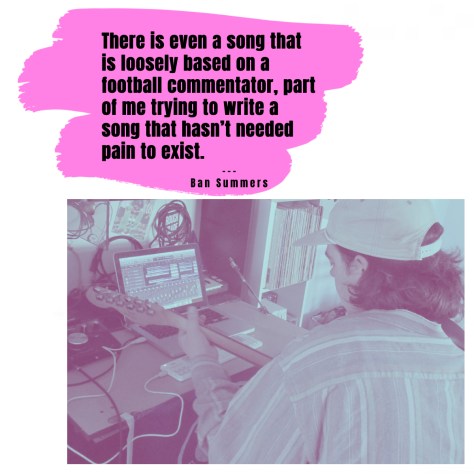
BS: There is indeed a new album. I only released Bean Summers last November but there was a lot of songs that flowed quickly afterwards and it was pretty much done 6 months after. But I wanted to allow people to get to know the songs a bit better, so I’m releasing it bit by bit at the moment before sharing the whole thing next year. I started with Drifting in May and now released Couldn’t Give A, which features shouting and sweary crowdsourced voice clips. The strange thing about waiting to release it is there’s even newer songs trying to fight their way onto it and maybe they will win out. The album could end up being quite a bit different to how it was intended a few months ago. There is even a song that is loosely based on a football commentator, part of me trying to write a song that hasn’t needed pain to exist.
In my wider life, we’ve just got Dottie, our 6-month-old rescue puppy and I have started writing about football finally, with an article on disabled football fans in When Saturday Comes magazine and helping out the England Amputee Football Association media team. It’s been great to find an outlet outside of music, which relieves some pressure on it, I think.
HK: Anything else you’d like to shout from the rooftops?
BS: I want to give a big shout to say thank you for taking the time to chat and shout like in Couldn’t Give A, with a big “f**k”.


