Pussy Riot in collaboration with Las Tesis have released a new single condemning police brutality, which seems only fitting to share now in memory of George Floyd and everyone else that has fallen victim to the brutal hand of the law.
Las Tesis, a feminist art collective from Chile, recently become famous for creating the choreography and protest song ‘A Rapist In Your Path’ which became a massive protest sensation around the whole world in 2019.
“May 2020. Either we organize ourselves or we perish. We are facing an unprecedented escalation of state brutality and repression. And with it, the historic opportunity to set it all on fire.”
Furthermore, on the Pussy Riot YouTube page, the collective goes on saying: “Make social workers being in charge of the police institution. Their goals should be to help people to deal with social and economical problems, not to punish them and kill for no reason, as they just killed George Floyd in the US. The government and the police are our servants. Too often they forget about it and think that it’s us who’re here to serve them.
5 STEPS FOR POLICE FROM PUSSY RIOT
1. Refocus police forces towards protection of the civilians instead of oppression and violent suppression of our rights to express and demand what our communities need.
2. We are here to hold the police forces accountable for every act of violence against civilians. Nothing will go unnoticed.
3. We demand that if the police show up at the demonstration, they protect our right to speak our minds freely, act respectfully and peacefully.
4. We are the many, they are the few. We stand together with Chilean protesters, we are women who want to be safe while marching for female rights with Las Tesis. We express our solidarity with Argentinian, Chilean, Mexican, Colombian, Brazilian, Peruvian, and all Latin American sisters and street fighters who only want to have a damn right to be in charge of their bodies and their reproductive system (but only get police batons in response).
5. Police forces in Latin America and Russia need to be urgently re-trained to focus on protecting women’s rights, LQBTQ+ community, and the rights of alternatively able people.”
This article was originally published in The Advocate
At the time of writing this article Chilean president Sebastián Piñera has declared a state of emergency in his country. In one of the strongest economies[1] in Latin America inequality reigns[2] and the country’s citizens are currently voicing their frustration by taking to the streets in protest.
Economic inequality is far from being the only thing Chileans have
had to protest in recent years. A little over four decades ago its
citizens had to experience a U.S. backed military coup that overthrew
the government. This resulted in more than 2,000 people being killed and
thousands of people tortured, among those internationally acclaimed
protest musician Victor Jara[3].
Events like these are bound to leave marks on a nation. It was not
until 2004 that the liberty flame that Pinochet ignited in 1975 was put
out. Not only are these flames (popular in many countries) a waste of
energy and usually commemorate war and violence, but for decades
families of those murdered by Pinochet had to see that flame burning.
The inequality in the country shows its teeth in other aspects of
society as well. Femicide (feminicidio), although not as rife as in
Mexico and Colombia, is a grave problem in the country. The term started
being used in Latin America due to the hundreds of women murdered in northern Mexico[4]
since the 1990s. A specific term had to be coined for this type of
homicide to design situations in which women were being murdered solely
because they were women.
One of the main problems for women living through this history of
violence towards them and their sisters is the lack of action from the
governments that are supposed to protect them. Fortunately, this is
changing – in some countries at least. In Chile, law number 20480[5], now also known as the femicide law, shows amends to violent intrafamiliar offenses[6]
and increases punishment for those crimes. These small steps come with
many hurdles still, because the people in power of the judiciary system
continue to find ways to lower sentences twisting language to their
ways.
But all is not lost and today rises a new generation of musicians and
activists that keep the protest flame lit and the legacy that Victor
Jara and other artists left behind alive. One of these artists are the
young women that make punk rock band Sin Lencería (which translates to
‘without lingerie’).
The band has been active since 2012 and since day one they have used their voices on and off stage to communicate to their audience the injustice their fellow women face in general society as well as in the very ‘machista’ punk rock scene. Their album Sin Lencería, Ni Miedos came out last August and, as they told me via email, the band has no other plans but to keep speaking up for women around the globe and fighting the good fight.
Halldór Bjarnason: Your music is a fighting
tool against gendered violence. How have you perceived ‘machismo’ and
gendered violence so far in the music scene around you and your
community since the start of Sin Lencería?
Sin Lencería: Even though the punk scene tries to be
more aware of social conflicts, it’s still in debt with gender related
problems. There’s still harassment at gigs and very little participation
of women in the public and as part of the bands and that’s something
that needs to change.
Being female musicians hasn’t been easy, the band started in 2012 and
since the beginning there’s been prejudice against us and the way we
play, some people used to think less of us just because we’re women and
because we look young. And sometimes even the compliments were weird,
like one time a guy told our drummer that she was so skilled that she
“played like a man”. He was trying to be nice but he didn’t even realise
that by saying that he was implying that women usually are bad at
playing their instruments.
But there’s still a bright side. There are some local collectives inside the punk scene that are trying to change this situation like “Femfest” or “Mujeres Al Frente”, they create different types of musical events that encourage inclusiveness and invite women to be part of the scene – providing safe spaces. Women are getting together and we’re raising our voices. “Mujeres Al Frente” has done 4 different feminist shows in these past years in Chile and one in Mexico. We love those events because they’re one of the few times that we get to see so many girls gathered together and at the center of the mosh pit with full energy!
HB: Has your music always been political or made in protest?
SL: Yes, since the beginning we’ve wanted to show
our discomfort and talk about the problems that affect women in their
daily lives. The band starts from that base point, from realising that
it’s time to talk about sex harassment, gender violence, feminicides,
discrimination, prejudice, etc. We need to change that Latin American
culture that’s so patriarchal that needs special words that does not
exists in other languages like “machismo” to explain how bad things are
and the lack of equality that exists.
HB: Feminicidio (feminicide) is a fairly
young term but an age-old problem that furthermore has been quite the
plague on South, Central and North American countries. How do you feel
your government is tackling this problem that you have sung about?
SL: In our country there’s still a long way to go
for these problems to be taken seriously. There’s been some improvements
over time but it’s not enough. A couple of years ago the government
created the “Ministerio de la Mujer y Equidad de Género”
(Ministry for Women and Gender equality) that supports women that are
victims of violence, providing legal and psychological help. There’s
also a “Ley del Femicidio” (Feminicide law), but these laws are
still too soft towards this type of problems and the feminicide law
only works for violence inside legally married couples or couples that
live together.
The Chilean law is working on new ways to protect women that are not
married and people that suffer couple/partner violence, but to this date
it’s still not approved. The only thing women can do when they suffer
harassment from a violent partner is to make a legal complaint with the
police and they’re usually very questioned in the process, and even if
they make repetitive complaints the best they can get is a restraining
order in most cases and, even then, they’re left with fear that the
violent partner could easily ignore the charges against them and find
the victims anyway.
An example of the problems with the femicide law in Chile, that also
affected the punk community, happened in 2017 with the murder of Isidora
“Dorito” González. Her case was very brutal and cruel because she
wasn’t only murdered, but her body was also dismembered. Once they found
the culprit and took him to trial, he was initially sentenced to 40
years of prison for femicide. But later his lawyers argued that the
victim and the culprit didn’t have a romantic relationship, nor they
lived together or were married, so his sentence changed from femicide to
simple homicide and they reduced his sentence from 40 to 15 years. And
that makes it clear that the laws are still very basic and don’t reflect
the Chilean reality, where women are still getting killed just because
they’re women.
HB: How do you feel people have been
receiving your feminist music? How do you get your message across to the
people that need to hear it the most?
SL: People have been very supportive in general, we think it’s because Latin America is going through a period of change and we’re speaking up for women rights and diversity. What we like about making songs is to think that the same things we feel and go through are also experienced by other women and at the end of the day we’re not alone, instead, we are a huge net of sisters fighting for the same reasons.
“…we like the fact that the song makes some people uncomfortable, because it’s the first step to start questioning why it makes them feel that way.”
But we’ve also been criticized by some people, especially because of our song “No quiero tus piropos”
(I don’t want your catcalls) that speaks against street harassment and
has some insults in its lyrics. But we like the fact that the song makes
some people uncomfortable, because it’s the first step to start
questioning why it makes them feel that way.
Our message flows in our songs by essence, but we also use other
resources to get our message across. Playing live is very important,
because it can help women to feel represented and motivated to start
their own bands. Sometimes we create zines and sometimes we use social
media to share our thoughts. We also try to participate as much as we
can in collectives like the ones that we mentioned before.
Besides, nowadays is easier to share our music because of technology, in the past the options were limited and even if your music got some recognition, there was the fear that the media would misunderstand your message, like what happened with the press blackout of the Riot Grrrl! movement in the 90’s. In our case we manage our own media and that give us a lot of freedom to express what we want and to have a closer bond with people.
HB: What do you hope to achieve with your music?
SL: We hope that our music works as support for
women that don’t feel protected or represented by social norms. And that
when they listen to us, they can feel freedom to shout as loud as they
can about everything that’s bothering them and that they had to keep
quiet in the past. On the other side, we also hope that singing about
these issues could help people to start questioning themselves and open
up to be a little more understanding and empathetic.
HB: What bands or musicians influence you? Are you following any contemporary protest musicians?
SL: Our strongest influence is Bikini Kill and all
of Kathleen Hanna’s projects in general. We’re also very inspired by L7,
Joan Jett, The Distillers, 7 Year Bitch and other classic punk and
postpunk bands like Ramones, Misfits, The Clash, The Slits and Siouxsie
& the banshees.
On a Latin American level, we have influences from the Peruvian band
Los Saicos, with his classic “Demolición” which we like to play live
from time to time. And we also feel influenced by Chilean bands like Los
Prisioneros, Los Ex and Lilits. In the present, we admire the work of a
lot of our fellow hardcore and punk bands like Portaligas, Dizclaimers
and Límbico. We’re also listening to music from around the globe and we
like bands like Vivian Girl, The Coathangers, The Regrettes, Skating
Polly and Hands off Grettel.
HB: What is on the horizon for you?
SL: At the moment, we want to keep speaking up for
feminism, we plan on continue making music and recording new material,
because we still have a lot to say. And in the near future we would love
to travel around sharing our songs.
HB: Lastly, thank you for participating and for your music. Anything else you’d like to shout from the rooftops?
SL: Don’t be afraid to make music, don’t be scared to say what you think if you feel something’s wrong, your opinions are important, you are important.
Being homeless for the first time at the age of 8 is perhaps, and hopefully, not something too many people can relate with. That was the reality for Stray, a young singer songwriter who just released her first album.
The protest music piece was recorded by herself on the farm where she now lives free from abuse and where she helps others get through similar things.
Halldór: First of all, for those who are not familiar with your work, who is Stray?
Stray: First homeless at the age
of 8, I once roamed the streets alone like a cat, rummaging through
the bins. At 21 I bought my first guitar at a flea market and started
teaching myself to play. I sing about social, environmental, and
economic justice in my music.
Halldór: You describe yourself as an artist who uses her voice to talk about issues that both have personally affected you as well as other things you deem necessary talk about. Why do you think music is such a great way to get political messages across?
Stray: The personal is political, I was homeless on and off due to severe abuse, couldn’t seek shelter at any of the local churches because I’m gay, and couldn’t afford apartments by myself due to poverty. So I was often trapped and choosing between an abusive home life or a homeless life.
These are traumas that I couldn’t talk about with people, both because trauma often makes us speechless, but because it had been dangerous for me to open up to people, and I also didn’t want to upset anyone else. You partially keep your trauma secret to nurture others.
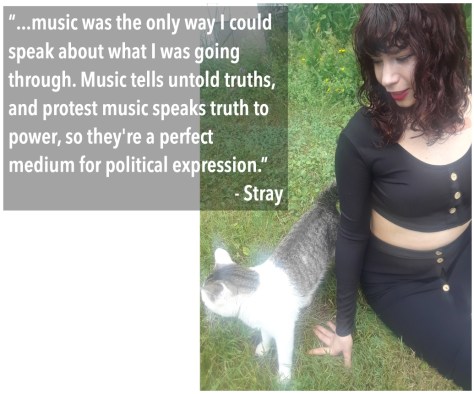
So music was the only way I could speak about what I was going through. Music tells untold truths, and protest music speaks truth to power, so they’re a perfect medium for political expression.
Halldór: Your debut album was recently released. Can you tell us about the creative and recording process of the album and the inspiration behind some of the songs?
Stray: These songs are my voice for when I had none. I wrote them during a time when I was terribly isolated. I had officially escaped from my abusive family, ending all contact with them, and was also escaping a different toxic environment.
I moved with all my savings to a broken down farm and started rebuilding myself from the ground up. This album tells that story. I believe Lost & Found, Burning Bridges, and Skeleton Key are the soul of the album. I recorded everything myself on the farm, turning a small bedroom into a little studio.
Even though the writing and recording of the album was done entirely alone, I now share my studio space with others, so that they don’t have to face the same financial obstacles I did along the way. I call it the Marginal Music Collective.
Halldór: Besides your music, which obviously is a tool for activism, what other activism do you partake in?
Stray: I believe in direct action and mutual aid. We can’t rely on hierarchical institutions to save us, many of them maintain the status quo or do more harm than good by entering communities and “saving” them by telling them they know “better”.
As a working class person myself, I grow food for the working class and homeless on my farm and share it with others for free and for donation. I volunteer with Food Not Bombs protesting environmental injustice, poverty, and imperialism, while feeding people.
When friends have been abused at home or were homeless, I’ve taken them in, knowing personally what it’s like to go hungry and go it alone, I refuse to allow that to happen to others.
Halldór: According to your Bandcamp profile you sound like a superhero, feeding people at your farm by day and recording protest music by night. Can you explain more about your farm and the life you live there with other people?
Stray: hahaha aww thank you! I founded Forest Moon Farm as a sanctuary for marginalized people and rescue animals. It’s a permaculture farm designed with environmentalist and organic principles and the garden is full of circles and spirals in accord with nature. I live here peacefully with two other people.
People come and visit to learn about organic gardening and permaculture, get free food, do yoga, and eventually when we can afford to rescue some animals, spend time with animals in nature. We even have a few acres of forest for nature walks.
“I’m Burning bridges cause I can’t afford the tolls It lights the way for all us beaten souls I’ve had to dive in to avoid the patrols And just keep swimming cause underwater is all I know”
from ‘Burning Bridges’ (2020)
Halldór: What musicians inspire you? Are you following other contemporary protest musicians that you want to give a shout out to?
Stray: My musical heroes are Janelle Monae, Fiona Apple, Taylor Swift, India Arie, and Ani DeFranco. I adore Blunted Lip by Laura Kerrigan, she has a beautiful voice, heartfelt lyrics, and a hilarious twitter full of queer pride and personality. I also love SoulSpot, they have great vibes and their singer and music are unbelievably smooth.
Halldór: What is on the horizon for you?
Stray: I’m doing a series of
house concerts this summer, writing my second album, and I plan on
adopting some goats!
Halldór: Thank you very much for participating and for the music. Anything else you’d like to shout from the rooftops?
Stray: Food, Housing, and Health Care are Human Rights!